Visiting Mercury: Facts, Mythology, and Future Exploration
Tried to spot Mercury? Good luck with that! This planet is a total Houdini, always hiding close to the Sun. Super tricky to see. But if you’re thinking about Visiting Mercury, even just reading about it, knowing its odd vibe helps. It’s far, yeah. And it mixes old legends with crazy science.
The Messenger Of The Gods
Why Mercury? Not just a random choice. Ancient folks, Romans especially, linked its super-fast dash across the sky to their god of talking and travel, Mercury. This dude, Hermes to the Greeks, was the top messenger. Total speed demon. Our zippy planet? Fits right in.
Get this: ancient Greek stargazers first thought they spotted two planets. One in the morning. One at night. Apollo and Hermes, they called ’em. But Pythagoras, way back in 500 BC? He finally nailed it. Same incredibly fast planet. What a revelation!
A World Of Extremes: Short Years, Long Days
Okay, get this in your brain: a year on Mercury? Shorter than its day. Wild, I know. It flies around the Sun in just 88 Earth days. But one Mercury day? Man, that drags. It’s about 176 Earth days. Crazy stuff.
This freaky time thing? All because of a weird tug-of-war, a gravitational lock, with the Sun. Mercury spins on its axis three times while going around our star twice. And you know what? This means really odd sunrises and sunsets, where the Sun even looks like it’s going backwards sometimes. Good luck trying to set your watch out there.
And another thing: Mercury’s orbit? Not even close to a circle. It’s the least round path out of any planet we’ve got. Earth goes in a nearly perfect circle. But Mercury’s? Stretched out. This means its distance from the Sun totally changes during its year. An interesting ride, huh?
A Cratered Veteran Sporting Heavy Scars
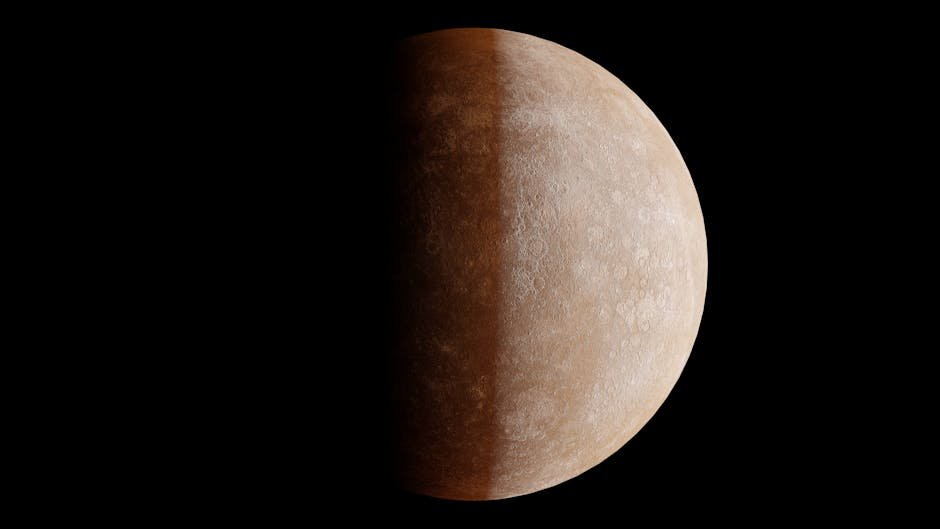
Picture an old boxer. Face all messed up from a lifetime of punches. That’s Mercury. Its surface is just peppered with holes, a clear clue of a vicious time about 3.9 billion years back. Asteroids? They just smashed into everything. A scarred, old planet.
One monster battle scar? The Caloris Planitia. This huge impact basin is a giant, 1,300 kilometers wide. Super-hot, equator-baked. Seriously, one of the last spots you’d want to hang out in our solar system.
Temperatures here? No joke. The sunny side hits a scorching 427 degrees Celsius. Hot enough to melt lead, zinc. But on the sides always in shadow? It drops to a brutal -183 degrees Celsius. And get this: even being so close to the Sun, scientists found hints of water ice. In those always-dark craters by the poles. Wild, right?
The Challenger: Why Studying Mercury Is Hella Tough
Watching Mercury? Not an easy gig for astronomers. Tough job. Close to Sun. Trying to get a good peek often means fighting crazy sun glare and heat. Even big telescopes, like Hubble, usually stay clear. Why? Because the Sun’s power could outright wreck their gear.
Never, ever look at Mercury with a telescope or binoculars when it’s near the Sun on the horizon. You’ll wreck your eyes. Seriously. Be smart, folks.
Scientists, decades back, totally confused by Mercury’s odd path. It just didn’t play by Newton’s rules. But then came Albert Einstein. He cracked the case with his general relativity theory, completely sorting out that tiny, slow shift in Mercury’s path. A huge win for modern physics.
Our Missions: MESSENGER And Beyond
With all these things going against us, getting a spacecraft to Mercury? That’s a huge deal. Mariner 10 did some flybys in the ’70s, getting us first looks. But the MESSENGER mission – named for the messenger god, fittingly – it really blew the doors open on the planet.
Launched in 2004, MESSENGER finally hit orbit around Mercury in 2011. For four whole years, it mapped the surface really well. Sent back tons of info. Then, mission done, it smashed into Mercury in 2015. So, yeah, bits of us are actually scattered on that scorched rock now.
So, while Visiting Mercury itself is still pure sci-fi, our robot buddies have given us an amazing peek into this small, fiery, yet weirdly icy world.
Frequently Asked Questions
Q: Why is Mercury so hard to see from Earth?
A: It’s always super close to the Sun in our sky. This closeness? Makes it tough to spot, all because of the Sun’s crazy glare and heat. Even strong telescopes, like Hubble, don’t point straight at it. Could mess them up.
Q: Does Mercury have water ice?
A: Yeah, it does! Even with that insane heat, scientists have found real signs of water ice. It’s in those craters near the poles, the ones always in shadow. No sunlight ever hits ’em, so they stay cold enough for ice.
Q: How long’s a day on Mercury compared to Earth?
A: A single day there? Really, really long. Like 176 Earth days. Get this: that’s actually longer than its orbital period. Meaning Mercury’s whole year is only 88 Earth days. Mind-bending.