Tsar Bomba: The Story of the World’s Wildest Nuke
Ever wonder what scary-huge destructive power looks like? Picture this. A weapon. So big. So terrifying. It could wipe out a whole city without even sweating. We’re talking about the Tsar Bomba, humanity’s biggest, most brutal creation ever. And this wasn’t just another bomb. It was a defiant roar right in the face of the nuclear arms race, showing just how far folks would go to “win.”
The Tsar Bomba (RDS-220) was the most powerful nuclear weapon ever detonated, with a yield of approximately 50 megatons
Let’s get right to it. The Tsar Bomba, officially called the RDS-220. Unofficially, Soviets called it “Ivan” or “Big Ivan.” It wasn’t just maybe powerful. It was the heavyweight champ. Weighed 24 to 27 tons (fuel-dependent, you know?). This beast measured 2.2 meters wide. And stretched a crazy 8 meters long. Moving it was a job.
Its main design? A mind-blowing 100-megaton yield. But they tested it at roughly 50 megatons. Still the biggest artificial boom ever. Think about that for a second. Even at half-power, shattered the Earth.
The Soviet Union developed the Tsar Bomba because of the Cold War nuclear arms race with the United States
The 1950s? Man, tense times. After the U.S. flashed its atom bombs in WWII, then threatened again with nukes, Moscow was not chill. This kickstarted an inevitable, all-out nuclear arms race. U.S. versus Soviet Union. Both sides scrambled to build bigger, deadlier things. Every single day.
Americans did the world’s first thermonuclear weapon test in 1954. Castle Bravo. 14-16 megatons. It sent shockwaves. Especially through Soviet leadership. They cranked up their own nuke program. Fast. Had a brief slowdown in ’58 for a test ban treaty, but both sides kept secretly designing weapons. By 1961, things got hot again. Berlin Wall went up. Soviet-Cuba relations warmed. The Communist Party bosses pressure on Nikita Khrushchev: “We need a bigger bomb than those imperialists!”
So, July 1961. Khrushchev called top scientists from Arzamas-16, their super-secret weapons joint. The team, led by Andrei Sakharov, had what he wanted. They could build a much stronger bomb. Even hit 100 megatons. Khrushchev was stoked and wanted this centennial bomb built in just 16 weeks, aiming for late October. Revolutionary celebrations, you know. Talk about a crazy deadline.
The bomb’s destructive power was so big, they thought it was useless for real fighting, so they scrapped it
Here’s the kicker. Even though it was meant as the ultimate show of force, the Tsar Bomba was just too damn much. Full 100-megaton blast? The fireball alone would be 4.5 kilometers wide. It would wipe out everything within 170 kilometers. Damage across 220 kilometers. Scientists figured this amount of damage could lead to wild ecological disasters. Widespread fallout. Even mess with global climate.
Because it sounded terrifying, Sakharov met Khrushchev again, August 1961. He got the leader to scale back the test. 50 megatons. Less bad. The bomb’s original three-stage setup—fission then two fusion stages—was actually changed. The third fusion stage’s fuel got swapped with lead. Significantly less radioactive fallout. Still kept bomb’s huge weight and size though.
But why ditch such a powerful weapon? Simply put, useless for fighting. Drop this thing? The whole region? Uninhabitable for years. Can’t even occupy it. And another thing: The Kremlin figured smaller, easier warheads, like on today’s ICBMs, were just way better. Modern ICBMs can chuck a dozen warheads. Each capable of flattening a city. So, one giant Tsar Bomba? Overkill. And a logistical nightmare. Didn’t fit the vibe of practical warfare.
Testing the Tsar Bomba messed up the environment big-time, proving these weapons could cause total disaster
Finding a “safe” spot in the massive Soviet Union for a bomb this big? Serious challenge. They finally picked Novaya Zemlya. An island up in northern Siberia. Chosen because practically nobody lived there. Just a few Eskimos and seasonal fishermen. They all got moved out.
To deliver this monster, Soviets modded a legendary Tu-95V bomber. The main issue? That plane needed to be 45 kilometers away when the thing went off. Or serious damage. To buy the bomber precious time, they stuck a giant 800-kilogram parachute onto the bomb. Slowed its fall. Even then, the plane itself was decked out. Painted a reflective white to bounce off thermal radiation. Lead plating in the cockpit for extra protection. A command plane watching from 100 kilometers away also got painted white.
On October 30, 1961, after a smaller 2.9-megaton test just days earlier, the tweaked Tu-95V took off. Dropped the 24-ton Tsar Bomba over Novaya Zemlya. It popped off about 4,000 meters (roughly 13,000 feet) above the ground.
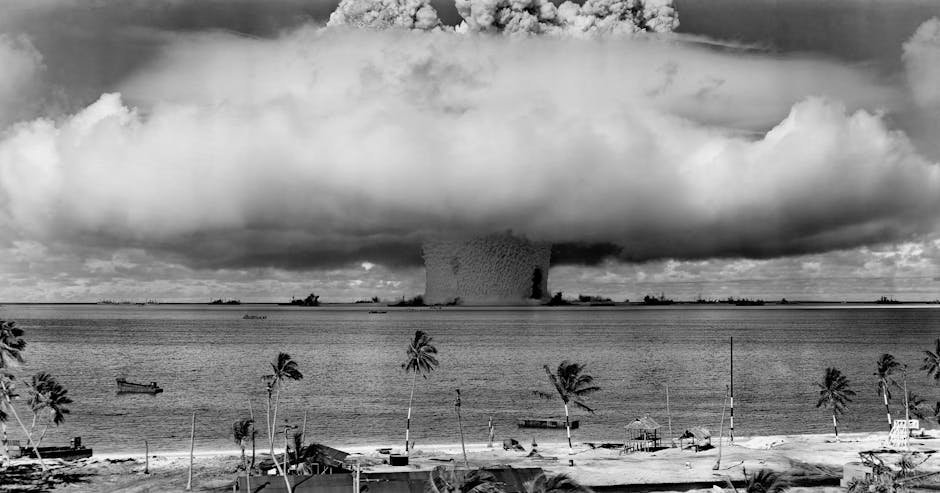
The aftermath? The mushroom cloud shot an incredible 64 kilometers (40 miles) high. The fireball’s diameter? 25 kilometers (15.5 miles). Everything within a 25-kilometer radius? Incinerated. Within 35 kilometers, buildings crumbled. Trees shattered. Cars vanished. Thermal radiation gave severe burns up to 70 kilometers away. The shockwave traveled 900 kilometers (560 miles). Shattering windows in houses within that enormous area. People in Finland, hundreds of miles away, reported clearly hearing the blast. Even though it was an airburst, the sheer power still left a crater. 4.5 meters wide, 50 meters deep.
Building and testing the Tsar Bomba shows how crazy things got during the Cold War. And how dangerous nukes are
So, the Tsar Bomba stands as a chilling monument. To humanity’s destructive power. To the desperate gamble of the Cold War. It showed just how far countries would go. All for “deterrence” and to be top dog. These kinds of monstrous weapons? Luckily, they mostly live in history books now. The world has mostly moved away from such impractical, devastating investments. Focusing instead on smaller, “tactical” (and still terrifying) nuclear arsenals.
Honestly, hope that kind of thinking stays buried in the past. Because if anyone ever tries something like this again, the consequences would be absolutely catastrophic. For everyone. Straight up.
Quick Questions
Q: What else did they call the Tsar Bomba?
A: Officially, RDS-220. But Soviets called it “Ivan” or “Big Ivan.” Americans? We knew it as the “Tsar Bomba.”
Q: Why wasn’t Tsar Bomba mass-produced or used?
A: Too big. Too much power. Useless for practical fighting. It’d turn huge areas into wastelands, rendering them unusable. Also, moving it? A total pain. Smaller, more flexible nuclear warheads are simply better.
Q: Where did they test the Tsar Bomba?
A: The only test detonation happened October 30, 1961. Over the remote Novaya Zemlya archipelago. That’s up in the Arctic Ocean, northern Siberia. Way, way out there.