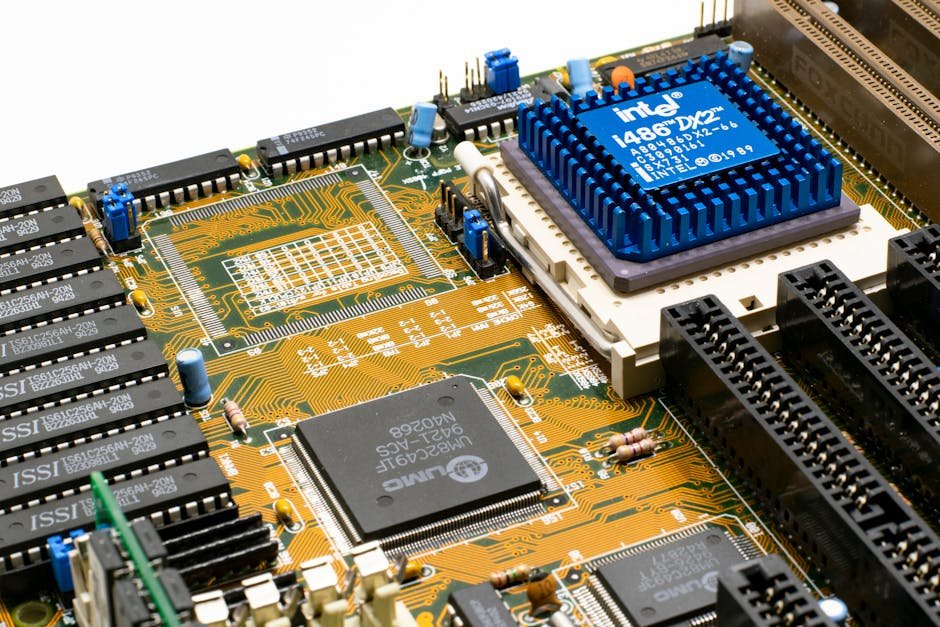
Ever peek at your phone and wonder how it does all that stuff? The Integrated Circuit History is wild, let me tell you. It’s truly amazing. This digital revolution? Started right here in California. And another thing: two super smart folks, nowhere near each other, somehow kicked off the digital age. Not just about tech. It’s about beating impossible odds.
Early computers hit a wall due to complexity and unreliability from vacuum tubes and individual transistors
Okay, so imagine this: 1957. Cold War. Intense. Not just about bombs, but brains. Who computes fastest? Targets better? Shoots to space higher? Computers were key. Not the sleek gadgets we have. No way. These were absolute beasts.
ENIAC, for example? Filled whole apartments. Weighed a ton. Packed with thousands of big glass things: vacuum tubes. Basically super light bulbs, kind of. They boosted signals. And another thing: they made rooms boiling hot. Sucked down power like crazy. The worst part? Always breaking. Engineers, literally, pushed wheelbarrows of spares. Try 10,000 tubes. Barely worked. More tubes, more power, many more headaches.
Transistors, from Bell Labs in ’47, seemed like the answer. Radios got tiny. Pocket-sized even. But that miniaturization sparked a new, sneakier problem. People, engineers mostly, started big dreaming: missile systems! Defense networks across continents! Satellite stations! But the whole thing slammed into a wall. Jack Morton at Bell Labs. He called it the “tyranny of numbers” in ’58.
What was the deal? More complex stuff meant you needed hundreds of thousands of transistors, resistors, little capacitors. And back then, you had to hand-solder every single tiny bit onto a board. Thousands of solder joints. Miles of skinny wire. Crazy spaghetti of cables. Every connection? A weak spot. One bad solder. One loose wire. A million-dollar rocket. Boom. Systems got heavy. Super expensive. Totally wouldn’t rely on them. Folks were stuck. Needed something simpler.
Jack Kilby of Texas Instruments made the first integrated circuit in 1958 with germanium and “flying wires.”
So, Jack Kilby shows up. Tall dude. Quiet. But super smart. Joined Texas Instruments in Dallas back in May ’58. He just wanted to make electronic parts smaller. TI was known for transistors, very aggressive.
Industry’s hot idea then? Micromodules: tiny parts on ceramic plates, then stacked up, wired. Kilby looked at it. Meh. Just neater soldering. Didn’t solve the real problem. Weeks into his new gig, July ’58, TI plant died down. Everyone on summer vacation. Kilby? No leave. Alone in this huge place. Lab was his. Hot Dallas summer. He churned on the big problem.
Then, bam. The monolithic idea. What if ALL the bits – transistors, resistors, caps – came from the same basic junk? One block of semiconductor material. Then, no wires needed between them. No soldering. Maybe connections in the material itself? Woah. Crazy talk back then. Everyone “knew” good resistors needed different stuff than good transistors. But Kilby said screw that rule. So he spent July proving it. Used germanium first.
He floored his bosses. Showed them a resistor and capacitor from one slab of germanium. Got the go-ahead. September 12, 1958. Kilby’s big moment. TI bigwigs Mark Shepherd and Willis Adcock gathered. On the table, a crude piece of germanium (about 1 cm²). Held by wax. Looked like a kid’s art fail, some said. Thin, gold wires, total make-do. “Flying wires,” they called ’em later. He hooked up power, an oscilloscope. Flipped a switch. A clear, steady wave popped up. It totally worked. First integrated circuit! Boom. Kilby theoretically beat the “tyranny of numbers.” TI filed patent Feb 6, 1959. But here’s the thing: those fragile, hand-connected flying wires? Revolutionary circuit. Still, not good for mass production. He’d mostly solved it. But that last 10%? Made all the difference.
Robert Noyce of Fairchild Semiconductor (California) put together a better, mass-produced integrated circuit in 1959
Okay, so across the country. 1959. California. Robert Noyce, a young physicist, was chewing on the same exact problem. No clue about Kilby and his wires. Noyce? Totally different guy than Kilby. Charismatic, outgoing. Risk-taker, big time. His story started with a massive walkout.
See, in ’57, Noyce led the “Traitorous Eight.” They famously bounced from William Shockley’s nutty management at Shockley Semiconductor. Went and started Fairchild Semiconductor. That place became the heart of Silicon Valley, truly. Fairchild had a whole different vibe than TI. Silicon was their thing. Better material than germanium. Higher temps, easier to make stuff with. And get this: Jean Hoerni, another brilliant mind from the Eight, dropped the revolutionary planar process late in ’58. This tech made transistors way more reliable. Good for mass production. Kept ’em safe. Fairchild was pumping out the best transistors anywhere.
January 23, 1959. Noyce was just thinking about Hoerni’s planar process. Then boom. His own “aha!” moment. Like Kilby, he saw the monolithic idea: all components from one piece. But! Noyce had the killer app Kilby lacked: the planar process. A total lightbulb moment. Kilby’s flying wires? Dead end. What if the connections—those annoying wires—could be printed right onto the silicon? Noyce realized you could open tiny “windows” in the protective film. Then, melt aluminum onto those spots. Make the connections. Like stenciling paint. This wasn’t some crude thing. This was it. The modern chip. Parts and connections all made at once. Via photo printing. No solder. No wires flying around. No human touch. Real mass production. Actual end of the “tyranny of numbers.”
Fairchild Semiconductor filed for Robert Noyce’s patent, “Semiconductor Device-and-Lead Structure,” July 30, 1959. Less than a year later. Two guys. Two states. Two related solutions. Same massive problem. The biggest patent fight ever? Just warming up.
A huge patent fight broke out. It only ended with a deal in 1966 that let everyone use the tech
So, at the U.S. Patent Office in ’59? Two stacks of papers. Totally unknowingly, they held the future. Kilby’s, from Texas, Feb 6, 1959. Noyce’s, from Cali, July 30, 1959. Both claimed to invent something called “integrated circuits.” Patent examiners were just stumped. The applications showed basically the same amazing idea, but totally different ways to do it. Who invented the thing? The idea man? Or the guy who made it work for real?
Kilby had the monolithic idea first. Showed it Sept 12, 1958. Single material, all components. But Noyce? He created the actual way to connect those parts. Planar process. Metallization. Made Kilby’s flying wires pretty useless for making tons of them. Patent Office took years to think. Meanwhile, both companies rushed their stuff out. TI launched first chips in ’60. Kilby’s design. Still those flying wires. A nightmare to build. Fairchild, using Noyce’s planar process, made way more solid, mass-produceable chips. So they shot to the top. Market was roaring. Tech was flying. The law? Dragging its feet.
First decisions from the patent office? Wild. Chaos. Noyce got Patent No. 2,981,877 in ’61. For his connection method. Huge win for Fairchild. Kilby’s big idea patent. Still waiting. Finally, ’64. Kilby got Patent No. 3,138,743. For the basic idea of the IC. So, Kilby had the foundational patent. And Noyce had the patent for the how-to that made the chip manufacturable. In plain English, no big chip maker could build circuits without stepping on one patent or the other. “Tyranny of numbers” was done. And another thing: “tyranny of law” just started. Industry stuck.
A brutal legal war. Ate up both companies all through the 60s. Courts. Patent offices. Armies of lawyers. Millions of bucks spent arguing “who was first.” Funny thing, this let other folks, like IBM and Motorola, jump in. But these two bigshots were just tearing each other apart. Until 1966. Both sides realized: no one’s winning. The industry was stalled. So, a deal happened. The “Great Partnership.” Or, cross-licensing agreement. TI and Fairchild agreed: use each other’s patents. Basically, they owned the invention together. This deal? It opened everything up. Countless companies then licensed and built on these core ideas.
The integrated circuit was key for Apollo, making tiny, reliable computers for space
Legal mess cleared in ’66. Now, the big question wasn’t if they could make a chip. It was, how much more stuff could they cram in there? Gordon Moore, another brainy Fairchild guy from the Traitorous Eight, dropped Moore’s Law in ’65. Said transistors on a chip would double every two years. Not just a guess. It became the industry’s playbook. But this new invention, it needed a near-impossible job to prove its worth. And that job came right from the Cold War: President Kennedy’s insane goal for the moon. Lander. Get safely home. Before 1970.
NASA kicked off Apollo in ’61. Huge problem: the computer for getting to the moon. Old room-sized computers? Forget it. No way that fit in a rocket. Needed a tiny, light computer. Barely used any power. And, super important, it had to work. Through all the rocket shaking. Space’s crazy conditions. No spaghetti wire jungles from before. No exploding tubes.
So, 1962. NASA did something incredibly gutsy. They decided: integrated circuits. Yup. These brand new, baby chips. For the MIT-designed Apollo Guidance Computer. A massive bet. National pride on the line. Astronauts’ lives. On tech barely out of the crib. And who built ’em? Robert Noyce’s company, Fairchild. The Apollo Guidance Computer became one of the first big uses of these new chips. Fairchild totally revamped its ways. To hit NASA’s insane reliability rules. Ran every chip through hellish tests. This hardcore process didn’t just make Apollo work. It totally remade how to make chips in Silicon Valley. Forever.
July 20, 1969. Neil Armstrong, steering the “Eagle” to the moon. Those critical minutes. His life rested on those small, one-centimeter square silicon chips. The Apollo Guidance Computer. Made landing happen. When Armstrong stepped out? Those tiny bits of silicon? Total game changer. “Tyranny of numbers” got officially smashed. On the moon. This win? Not just the space race. It changed everything.
This invention led to the microprocessor (like Intel 4004 in 1971), starting the personal computer craze
- Robert Noyce, and Gordon Moore too, left Fairchild. Started their own company: Intel. Fast forward to ’71. Intel dropped the Intel 4004. Not just another integrated circuit. This was a microprocessor. Because for the first time? Not just one circuit. The entire brain of a computer. All on one chip. That was it. First step. Personal computer revolution, here we come.
Today? Everywhere. Our phones. Cloud stuff. AI. Your car. All those use boosted versions of that first chip. Two super smart guys. Cracked the same problem, around the same time. Totally different ways. Their invention? Flew to the moon with Apollo. Then came home to our desks with the microprocessor. Just incredible.
Kilby and Noyce were pioneers, transforming the world. Kilby got a Nobel Prize
So, these two legends? What happened to ’em? Robert Noyce became like, “the Mayor of Silicon Valley.” Made Intel a huge deal. One of tech’s most respected folks. But sadly, heart attack in 1990. Only 62. Built this whole world. Never saw it at its absolute peak.
Jack Kilby. Always the “silent giant” from Texas. Kept working at TI. Helped invent the thermal printer. And the first pocket calculator! Quiet guy, engineer. Just lived his life.
Years went by. People finally got how big their invention was. Then, 2000. Big news. The Royal Swedish Academy of Sciences. Nobel Prize in Physics. Went to Jack Kilby. “For his share in the invention of the integrated circuit.” “His share,” notice that. Not “for the invention.” The Nobel folks basically said: hey, wasn’t just one person. Was about rivalry. And parallel smarts. And since they don’t give Nobels to dead people, Noyce, who died in ’90, missed out.
But maybe the coolest part? Kilby’s own words. After his Nobel, he wrote, “If Robert Noyce were still alive, I have no doubt that we would be sharing this award.” A true sign. Respect, you know? Between two rivals. Together, they built our modern world. Your phone today? Billions of times more powerful than the entire Apollo program going to the moon in ’69. All that power? Because two engineers, in ’58 and ’59, had no clue about each other. Fought the tyranny of numbers. One nailed the problem. The other made it real. First one: germanium. Flying wires. The next: silicon. Aluminum. Their fight? Ended up with peace we all benefit from. Started simple. Seeing endless possibilities in sand.
FAQs
Q: “Tyranny of numbers”? What was that about?
A: Basically, early computers. They got so insanely complex. So unreliable. Engineers wanted bigger machines, but needed tons of parts. Vacuum tubes, transistors. Massive systems with loads of little, hand-soldered connections. Always failed. Got too hot. Blew through power like crazy.
Q: Who invented the integrated circuit?
A: Jack Kilby (from Texas Instruments) and Robert Noyce (Fairchild Semiconductor). Both got credit. Kilby first showed the idea with a germanium prototype and “flying wires” in 1958. Then Noyce, independently, cooked up a way better version using silicon and the planar process in 1959. That’s kinda the modern chip’s start.
Q: Did Apollo help chips get big?
A: Oh yeah. NASA chose integrated circuits for the Apollo Guidance Computer in ’62. Huge gamble! Proved the tech worked for super important stuff. Space missions needed chips to be ridiculously reliable. NASA pushed guys like Fairchild to majorly step up their chip making. Made them stronger. Better for space travel. And because of that? More people trusted chips. Everyone started using them.